
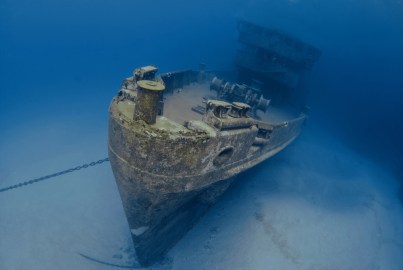
 USS Kittiwake

Since its sinking in January 2011, the 251-foot former USS Kittiwake has been covered in marine life such as like horse-eye jacks, sergeant majors, blue tangs and squirrelfish – and has won the hearts of divers. The most exciting new resident is a 100-pound goliath grouper that’s often found near the wreck’s propeller. The former Chanticleer-class submarine rescue vessel sits on the seafloor off Seven Mile Beach, and rises to within 15 feet of the surface. The Kittiwake had an illustrious service for more than 54 years, being decommissioned September 30, 1994.
U-352
U-352 is the premier wreck of North Carolina’s Outer Banks—and in an area known as the “Graveyard of the Atlantic,” that’s saying something. On May 9, 1942, the German sub mistakenly fired on the U.S. Coast Guard cutter Icarus, which dodged the torpedoes and answered with a depth charge attack that forced the U-352 to the surface. The sub’s commander ordered his crew to scuttle their vessel and abandon ship. Although its outer hull has long since rusted away, the pressure hull remains intact, sitting on the sandy bottom with a 45-degree list to starboard.
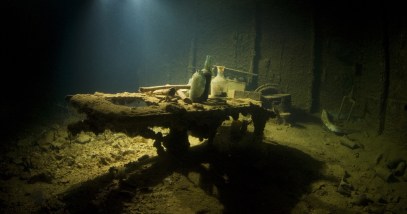 Shinkoku Maru

The tanker Shinkoku Maru was built in 1941 for the Japanese navy and took part in the Pearl Harbor attack as a support ship. In a twist of fate, the 500-foot vessel was sunk a little more than three years later in the U.S. sneak attack on Truk Lagoon known as Operation Hailstone. American Avenger torpedo bombers fired seven times at her, the last one hitting her aft starboard side and sending her to the bottom. Today, this ship is covered with coral formations and considered one of the best night dives among the numerous wrecks of Chuuk Lagoon.
USAT Liberty
A World War II cargo ship brought to her end by a lucky Japanese torpedo, the USAT Liberty is one of Indonesia’s most interesting dive sites. Her 400-foot body, broken in many places but beautifully overgrown with colorful soft corals, rests on a steep, black-sand slope just a stone’s throw off Tulamben’s cobble shore. Starting at the stern in just 25 feet of water, the critter-encrusted wreckage angles down to the bow section at 110 feet. The ship also hosts more than 400 species of fish, including thousands of bigeye jacks, which can be found swirling over the wreck like a silver storm cloud.
Odyssey
Diving this 300-foot freighter, intentionally sunk at a site called Mud Hole, is a delight. The Odyssey is split into three pieces and is perfectly positioned between two lovely coral reefs. The setting is inspirational, but it’s the lofty vertical presence of the stern that grabs photographers’ attention. Her wheelhouse is nearly 85-feet tall. The complex network of steel railings and stairways presents a visage reminiscent of New York City fire escapes.
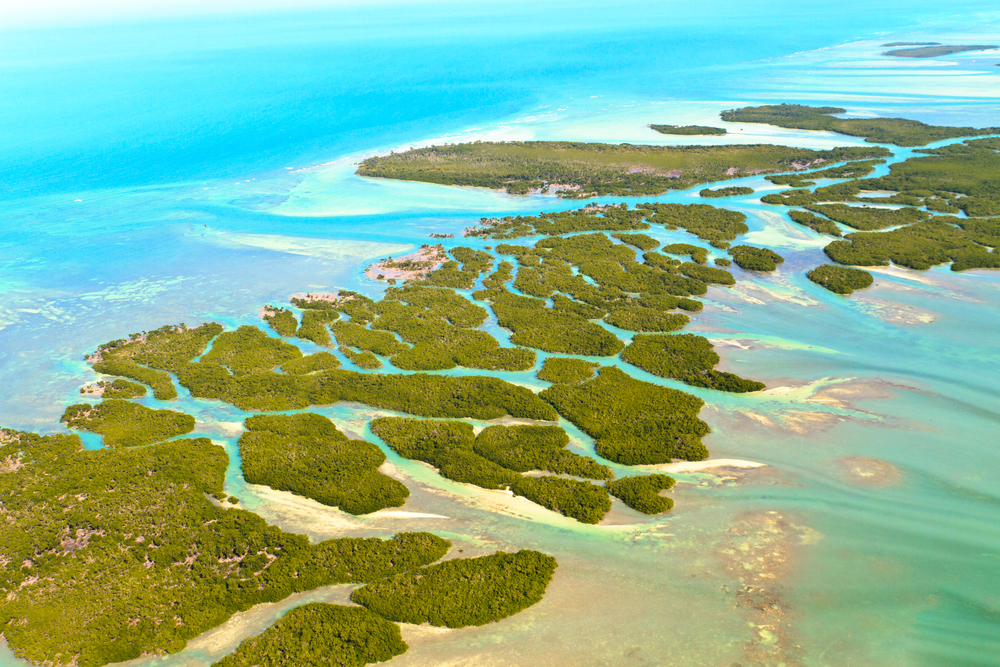
Treasure hunters from around the world have looked at the Florida Keys as a place of rich pickings. The Nuestra Señora de Atocha was one of the most famous fleets of Spanish ships to succumb to the sea. The fleet sank in 1622 off the Florida Keys while carrying copper, silver, gold, tobacco, gems, jewels and indigo from Spanish ports at Cartagena and Porto Bello in New Granada, and Havana, bound for Spain. The ship was named for the parish of Atocha in Madrid.
 An unfortunate series of complications kept the Atocha in Veracruz before she could rendezvous in Havana with the vessels of the Tierra Firme Fleet. The treasure arriving by mule to Panama City was so immense that summer in 1622 that it took many months to record and load the precious cargo onto the Atocha. After still more delays in Havana, what was ultimately a 28-ship convoy did not manage to depart for Spain until 4 September, 1622—six weeks behind schedule.
On 6 September, the Atocha was driven by a severe hurricane onto the coral reefs near the Dry Tortugas, about 35 miles west of Key West. With her hull badly damaged, the vessel quickly sank, drowning everyone on board except for three sailors and two slaves.
After the surviving ships brought the news of the disaster back to Havana, Spanish authorities dispatched another five ships to salvage the Atocha and the Santa Margarita, which had run aground near where the Atocha sank. The Atocha had sunk in approximately 55 feet of water, making it difficult for divers to retrieve any of the cargo or guns from the ship. A second hurricane in October of that year made attempts at salvage even more difficult by scattering the wreckage of the ship still further.
The Spaniards undertook salvage operations for several years, with the use of Indian slaves, and they recovered nearly half of the registered part of the vast treasure from the holds of the Margarita. The principal method used by the Spanish for the recovery of this cargo was a large brass diving bell with a glass window on one side—a slave would ride to the bottom, recover an item, and return to the surface by being hauled up by the men on deck. It was often lethal but considered the most effective way of recovering the treasure at the time.
 The loss of the 1622 fleet had an immediate impact on Spain, forcing it to borrow more to finance its role in the Thirty Years’ War and to sell several galleons to raise funds. While their efforts over the next 10 years to salvage the Margarita were successful, the Spanish never located the Atocha.
An American treasure hunter named Mel Fisher and a team of sub-contractors, funded by investors and others in a joint venture, searched the sea bed for the Atocha for nearly seventeen years; Fisher had earlier recovered portions of the wrecked cargo of the sister ship Santa Margarita in the early ’80s. He also proposed the idea to several other potential helpers who were discouraged by the fact that this dangerous professional diving job was at minimum wage unless the ship was found. The Atocha wreck and its mother lode of silver, gold and emeralds was finally discovered in July 1985. The salvaged coins, both gold and silver, were minted primarily between 1598 and 1621, although numerous earlier dates were represented too, some of the dates extending well back into the 16th century. Many of the dates and types of the period had been either rare or unknown prior to the salvage of the wreck.
After the American Revolution, Spain regained control of Florida from Britain as part of the Treaty of Paris. When the British evacuated Florida, Spanish colonists as well as settlers from the newly formed United States poured into the territory. Many of these new residents were lured by favorable Spanish terms for acquiring property, called land grants. Even Seminoles were encouraged to set up farms, because they provided a buffer between Spanish Florida and the United States. Escaped slaves also entered Florida, trying to reach a place where their U.S. masters had no authority over them.
Instead of becoming more Spanish, Florida increasingly became more “American.” Throughout the 19th Century, a series of conflicts took place in the territory called “The Seminole Wars.” These conflicts would eventually help shape and form modern day Florida.
 The First Seminole War

During the British occupation, the British often incited Seminoles against American settlers who were migrating south into Seminole territory. These old conflicts, combined with the safe-haven Seminoles provided black slaves, caused the U.S. Army to attack the tribe in the First Seminole War, which took place in Florida and southern Georgia. Forces under Gen. Andrew Jackson invaded Spanish Florida, attacked several key locations, and pushed the Seminoles farther south into Florida.
Finally, after several official and unofficial U.S. military expeditions into the territory, Spain formally ceded Florida to the United States in 1821, according to terms of the Adams-Onís Treaty.
As soon as the United States acquired Florida, it began urging the Indians there to leave their lands and relocate along with other southeastern tribes to Indian Territory—present-day Oklahoma. Some Seminole leaders signed a treaty in 1832, and part of the tribe moved. But other Seminoles refused to recognize the treaty and fled into the Florida Everglades.
The Second Seminole War
The Treaty of Payne’s Landing, signed by a small number of Seminoles in May 1832, required Indians to give up their Florida lands within three years and move west. When the U.S. Army arrived in 1835 to enforce the treaty, the Indians were ready for war.
As Major Francis Dade marched from Fort Brooke toward Fort King, 180 Seminole warriors led by Micanopy, Alligator and Jumper attacked. Only one man of that army detachment survived the ambush.
The campaigns of the Second Seminole War were an outstanding demonstration of guerrilla warfare by the Seminole. The Micos Jumper, Alligator, Micanopy and Osceola, leading less than 3,000 warriors, were pitted against four U.S. generals and more than 30,000 troops.
The Second Seminole War, usually referred to as the Seminole War proper, was the fiercest war waged by the U.S. government against American Indians. The United States spent more than $20 million fighting the Seminoles. The war left more than 1,500 soldiers and uncounted American civilians dead. And the obvious duplicity of the U.S. government’s tactics marred Indian-white relations throughout the country for future generations.
As the hostilities dragged on, frustrated U.S. forces increasingly turned to desperate measures to win the war. For example, Osceola was captured and imprisoned when he met with U.S. troops who had called for a truce and claimed to want to talk peace.
 With Osceola in prison, the United States was confident the war would end soon. But it did not. Although Osceola died in prison in 1838, other Seminole leaders kept the battle going for a few more years.
In 1842, a nominal end to the hostilities arrived, though no peace treaty was ever signed. By this time, most Seminoles had been moved from Florida, relocated to Indian Territory in today’s Oklahoma.
The Third Seminole War
A Third Seminole War broke out in 1855, when conflicts — largely over land — arose between whites and some Seminoles who remained in Florida. Constant military patrols and rewards for the capture of Indians reduced the Seminole population to about 200 when the Third Seminole War ended in 1858.

Tides Of Fortune: Book Three
“A gripping tale of pirate adventure off the coast of 19th Century Caribbean!”
A thrilling high-seas adventure series from renowned storyteller Steven Becker.
 A fortune in gold and the future of a nation are at stake. King Henri is dead leaving Haiti in disorder and his treasury empty.
A mysterious crewman is able to interpret a series of cryptic clues leading the crew on a chase through the mountains and fortresses of Haiti. With his own goal of taking over the nation, the political intrigue builds, but nothing is as easy as it seems.
Follow Nick and the crew of the Panther in this stand-alone installment of the best-selling Tides of Fortune series.
Available in Kindle and Paperback


Ching Shih was the Chinese prostitute who became one of the most powerful female pirates of her time through her control of the Red Flag Fleet. Under her command, the fleet grew and became one of the most organized system of businesses on the seas. With huge resources, she had (for a short time) the power to rival any government in the world.
Little is known about Ching Shih’s early life apart from the fact that she was born in the Guangdong province of China around 1775. She became a prostitute on a floating brothel in Canton, and the infamous pirate Zheng Yi, the leader of the Red Flag Fleet, noticed her beauty and had the floating brothel plundered to gain ownership of Ching. After his men had plundered the brothel, she was brought before Zheng, and he asked her to marry him. She agreed—but asked for an equal share of his plunder. Soon, the two of them were running the Red Flag Fleet together in harmony.
 Under their joint leadership, the Red Flag Fleet grew quickly from under 200 ships to over 600 ships, which eventually grew to almost 2000 ships. The fleet was color coded and organized into red, black white, yellow, blue and green fleets. Zheng Yi died in 1807 only 6 years after marrying the beautiful Ching Shih. At the time of his death, the fleet contented nearly 100,000 pirates. Ching was faced with two choices. She could return to her life of prostitution or rise to become one of the most powerful female pirate lords of all time, but she craved the power and glory of being the leader of the organization. With the help of Zheng Yi’s second-in-command, she took charge.
As a leader, she was strict and controlled. She was driven by business and strategy and even went so far as to try and form a government that would protect her pirates through laws and taxes. All plunder captured was registered before distribution and the ship that captured the loot was entitled to retain just over 20% of its value—the rest of its value would go into the fleets coffers.
Ching Shih set forth rules that protected captured prisoners. Female prisoners were released. A pirate who wished to take a beautiful captive as a wife was free to do so—but was bound to treat her as he would a wife. Unfaithfulness and rape were both offenses for which a pirate could be executed.
As Ching Shih took leadership over many coastal villages, word got back to Canton. The Chinese offered amnesty to all pirates hoping to end her reign over the sea.
The Red Flag Fleet under Ching Shih’s rule could not be defeated — not by Qing dynasty Chinese officials, not by the Portuguese navy, and not by the British. But in 1810, amnesty was offered to all pirates, and Ching Shih took advantage of it. She ended her career that year, accepting an amnesty offer from the Chinese government. She kept her loot and opened a gambling house. She died in 1844, at the age of 69.
Haiti, an island nation that has suffered much in its existence, manages to thrive as a cultural and historical treasure trove, with its unique and varied lifestyle of its peoples, their cultures, and the deep history one can feel when they arrive.
 Of the many sights beckoning you, no visit to Haiti would be complete should you be so unfortunate as to miss out on see the largest fortress in the Americas.
I am speaking of the “Citadelle Laferriere” in Haiti. It was constructed starting in 1810 and finished three years later in 1813 by the first king of northern Haiti, King Henri Christophe I. Built five miles from the town of Milot up on a mountaintop (you may want to rent one of the horses available to for the trek up), one is truly impressed with the undertaking that went into just getting the materials, armaments and supplies there.
As you come upon the fortress itself, you are awestruck by the sheer magnitude of such a structure. The walls rise an amazing one hundred thirty feet from the ground and are an incredible ten feet thick. Now, I could give you a whole list of facts and figures, such as there are three hundred sixty-five cannons of various sizes, complete with a massive stockpile of cannonballs, or that it was designed to fend off a French 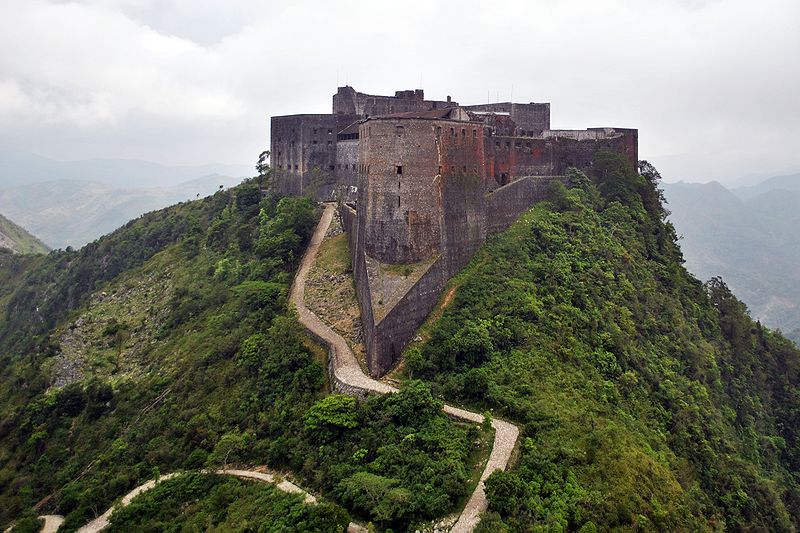 invasion (that never came about), or the fact that not only did they have running water throughout and that every “apartment” was “air conditioned” using the water in their design. But what is really intriguing is that it could sustain five thousand people for a whole year with its larder and water supply. Should they have come under siege, I’m pretty sure they could have outlasted even the staunchest enemy.
When one walks in the many halls and rooms, your footfalls echoing in the many buildings, you get the feeling a living history has come back, wanting to show you its many stories, share with you the heartache and pain felt by the tens of thousands of laborers, so many of whom perished in the citadel’s construction and the trying times during Haiti’s struggle to be a free nation in a bygone era.
To say the view from Citadelle Laferriere is impressive would not do it justice. Situated on the pinnacle of the mountaintop, if one stood in one place and turned three hundred sixty degrees, on a clear day, you could see the highest mountain in Haiti and the Atlantic Ocean.
Do yourself a favor and put this stop on your bucket list. You won’t regret it, I can promise you.
Toll Roads
Florida has more toll roads and bridges than any other state in the Union.
 The Fern Capital

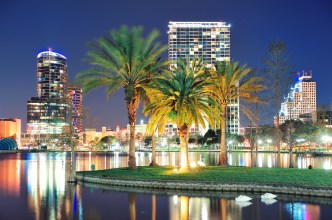
The small town of Pierson in northeast Florida is known as the Fern Capital of the World. Ferns from farms here are shipped worldwide, and these farms can be seen everywhere in the area.
High Point of Florida
The highest point in Florida is only 345 feet above sea level. Britton Hill is in the Florida Panhandle. The highest point in Florida’s peninsula is Sugarloaf Mountain near Clermont at 312 feet.
A Game of Golf?
Florida has more golf courses than any other state and is home to the World Golf Hall of Fame and Museum in St. Augustine.
 Crocodiles and Gators…

The Florida Everglades are the only place on the planet where crocodiles and alligators live together.
Flowing with the River
Florida’s largest river, the St. Johns River, is one of only a few major rivers that flow from south to north.
Watermelons or Oranges?
Florida is the largest producer of watermelons in the country. It also produces the most tomatoes, strawberries and sugar.
Florida Pine
Made mostly of Florida pine, the Belleview Biltmore Resort and Spa, northwest of Tampa Bay, is said to be the world’s largest occupied wooden structure at 820,000 square feet.
Largest Cities
You may be surprised to learn that in terms of area, Jacksonville, Florida is the largest city in the United States.
Busy Disney
Sure, there are long lines at Disney World. After all, annual attendance is about 17 million people. That’s over 45,000 people per day on AVERAGE. Busy days will see over 100,000.
The Fridge
It would make sense that mechanical refrigeration was invented in Florida. In 1851, Dr. John Gorrie of the little town of Apalachicola created the invention.
 Labadee
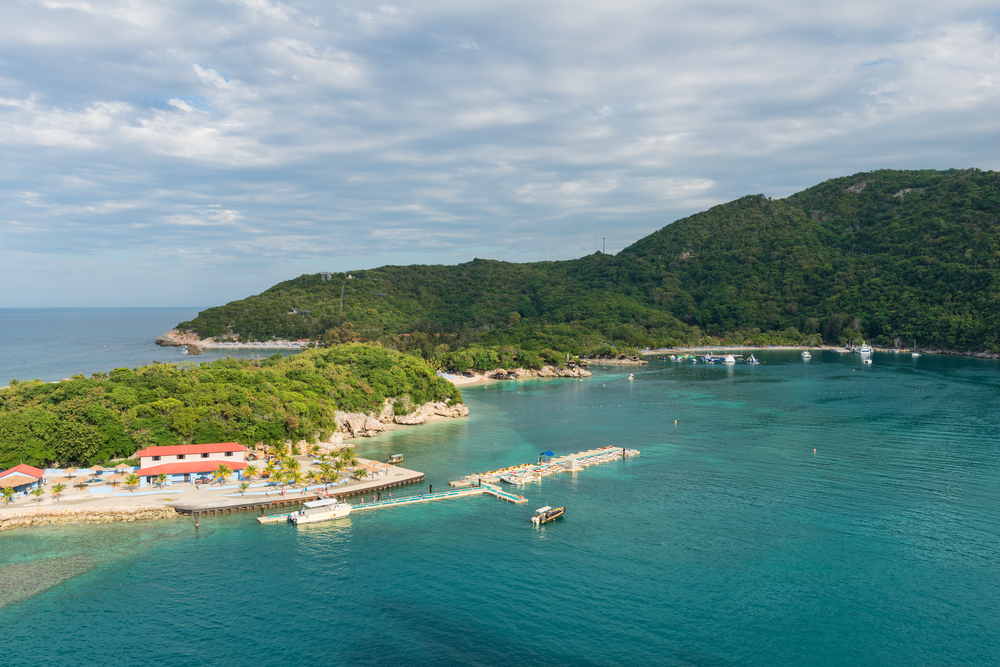
Probably the most popular place to visit in Haiti, Labadee is a wonderful island area that features beaches with a large expanse of sand and surf. The palm trees that line the beach offer relief from the endless Haitian sun, and the beach is perfect for relaxation and sunbathing. Hammocks, beach chairs and beach huts are in abundance, and for those who like an active vacation destination, there are plenty of underwater activities to undertake—kayaking, swimming, snorkeling and even motorized watercraft.
 The Citadelle Laferriere
The Citadelle, as locals call it, is the largest fort in the entire western hemisphere. It is located in a remote location, but it’s worth the journey to see it. On top of a mountaintop, the fort was built in the early 1800s as a way of defending Haiti during its early days of independence. Just be careful—there are no guardrails in place on top of the fortress walls and rooftops, and it’s a long drop from the top of the fort to the bottom of the mountain!
Jacmel
Jacmel lies on the southern coastline of Haiti. It’s a beautiful city filled with Victorian architecture. Don’t forget to visit Pac Macaya, the nearby national park. The southern coastline features many trails to walk and sights that are seldom seen by visitors. If you want to stay in the city, you can take advantage of the world class restaurants, shopping malls, and Bassin Bleus—a series of three lakes joined by a waterfall.
Petionville
Visiting the capital city of Port au Prince may be the easiest way to see Haiti—but travel to the nearby suburb of Petionville to see some of the most breathtaking architecture Haiti can offer. Petionville is a beautiful area filled with true Haitian food—upmarket, but without the tourist population.
Jacquotte Delahaye
Jacquotte Delahaye is the subject of many legendary stories. Nicknamed ‘Back from the Dead Red’ after she faked her own death to escape government pursuit, Haitian Jacquotte was a red-headed beauty who operated in the 1600s. She led a gang of hundreds of pirates, and with their help took over a small Caribbean island in the year of 1656, which was called a “freebooter republic.” Jacquotte first took up piracy to earn enough to support her mildly brain damaged brother when both her parents died. With compassion and cunning balanced in equal measure, she was one of the most successful pirates ever to set sail.
 Anne Dieu-Le-Veut
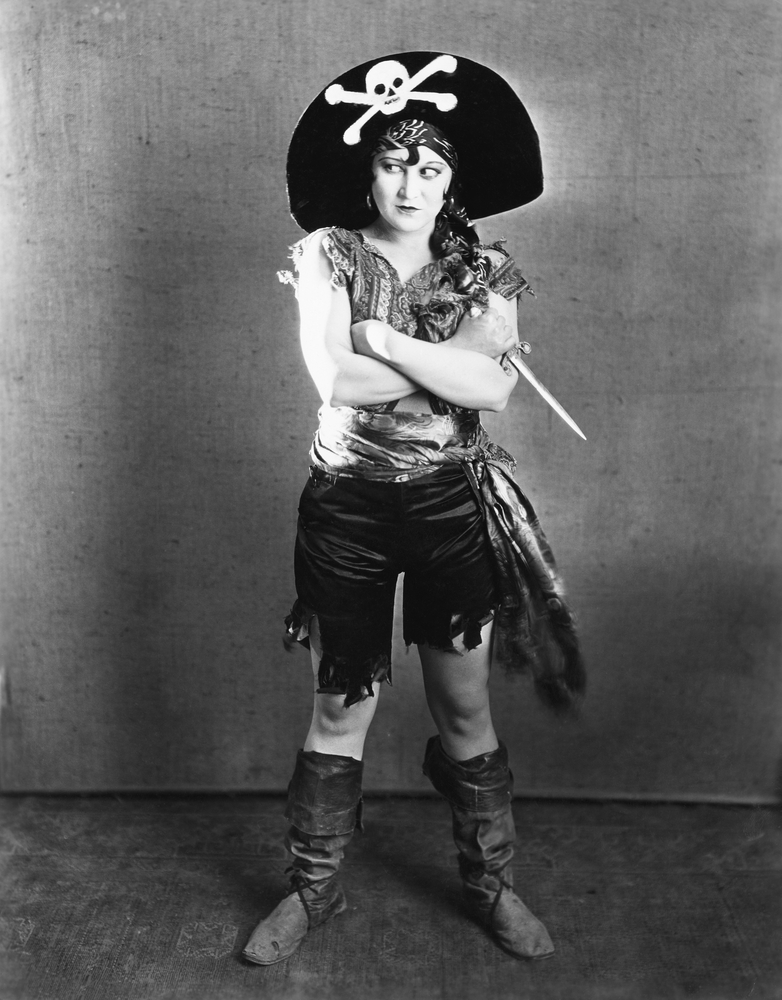
Already a known criminal in her native Tortuga, Anne Dieu-Le-Veut was deported to France where she married notorious pirate Pierre Length. He was killed in 1683 by Laurens de Graaf, a fellow pirate, in a bar fight. Anne was understandably enraged and challenged Laurens to a duel, but he was so awe-struck by her gutsy nature, he turned down the match, and instead he proposed marriage. Apparently incredibly fickle, Anne accepted and continued to sail the seas with her felonious hubby in tow.
Anne Bonny and Mary Read
Irish Anne was born between 1667 and 1700. She was disowned by her father for stabbing a servant girl and later marrying pirate James Bonny. They moved to the Bahamas. Here she moved up in the freebooter ranks, leaving her husband for Jack “Calico Jack” Rackham, captain of the Revenge.
Mary, on the other hand, was forced into piracy when her ship, headed for the Caribbean, was captured by pirates. She later ended up on Calico Jack’s ship, though Anne was unaware her fellow female buccaneer, Mary, was disguised as a man. It wasn’t until Anne took a fancy to Mary’s pretty face, and Calico Jack, in jealousy, threatened to make it look a little less pretty that Mary revealed herself.
Both women continued threatening the oceans until their luck ran out, and the Revenge was intercepted by Captain Jonathan Barnet while her crew were in the midst of a party. Too drunk to fight, most of the pirates left the dirty business to the women, and rumor has it they were excellent fighters. All were eventually captured, but the two women evaded immediate execution by claiming they were both with child. Mary died in prison in 1721, but Anne disappears from the record, neither recorded as executed or released, and it seems we can guess at whether she lived to fight another day.
Hi all,
So far this month you’ve had the chance to download Relic (Mac Travis Series #1), Pirate (Tides of Fortune #1) and Bonefish Blues (Will Service #1), all for just $0.99. For the final week in the January sale I’m giving you the chance to download the second book in the Tides of Fortune series – The Wreck of the Ten Sail. This gives you the opportunity to catch up with the series before the release of book 3 – Haitian Gold – which will shortly be released.

18 January – 24 January
$0.99



 Steven Becker